As the volume of end-of-life photovoltaic (PV) panels increases, efficient disassembly has become a critical step in solar recycling. Two main approaches dominate the industry: mechanical methods and thermal (pyrolysis-based) methods. Each offers distinct advantages in terms of cost, efficiency, and material recovery. Choosing the right approach depends on operational goals, panel types, and investment strategy. At YUSHUNXIN, we manufacture solar panel recycling equipment designed to deliver practical, high-efficiency mechanical solutions for large-scale PV disassembly.
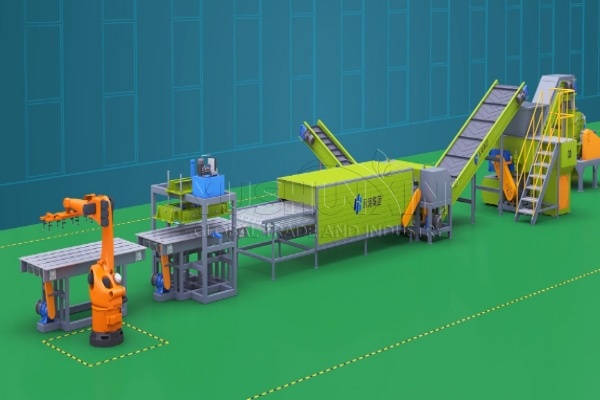
Mechanical Disassembly: Scalable and Cost-Effective
Mechanical methods rely on physical processes such as frame removal, glass separation, crushing, and sorting. This approach is widely used in commercial recycling due to its simplicity, scalability, and relatively low operational cost.
YUSHUNXIN mechanical recycling systems begin with automated frame removal and glass separation, significantly reducing the load on downstream processes. Controlled crushing then breaks down the remaining materials, allowing separation systems to recover glass, metals, and silicon fractions. For facilities focused on efficient material recovery, automated dismantling equipment provides the foundation for stable, high-throughput operations.
Mechanical disassembly is particularly effective for handling large volumes of mixed solar panel waste, including both single-glass and double-glass modules. It offers high throughput and stable output, making it suitable for industrial-scale operations.
Thermal Methods: Deeper Material Separation
Thermal methods, often based on pyrolysis technology, use high temperatures in an oxygen-free environment to decompose encapsulation materials such as EVA. This process can help separate bonded layers more thoroughly, especially in complex panel structures.
While thermal treatment can improve access to certain internal materials, it requires specialized reactors, precise temperature control, and emission management systems. These factors increase both capital investment and operational complexity. For a real-world application, the PV panel recycling project in India demonstrates how thermal methods can be integrated into a complete recycling strategy.
In most cases, thermal methods are used as a complementary process rather than a primary solution for large-scale disassembly.
Cost and Efficiency Comparison
Mechanical systems generally have lower upfront investment and lower operating costs. They also provide higher throughput, allowing faster processing of large quantities of PV panels. Understanding the key factors in equipment pricing helps businesses make informed investment decisions.
Thermal systems involve higher energy consumption and more complex maintenance requirements. Although they may offer advantages in specific material recovery scenarios, their overall efficiency must be evaluated against increased cost and slower processing speed.
Choosing the Right Method for Your Operation
The decision between mechanical and thermal methods should be based on feedstock composition, capacity requirements, and financial objectives. For most recycling businesses, mechanical disassembly provides the best balance of efficiency, cost control, and scalability.
Thermal methods may be considered in niche applications where deeper material separation is required, but they are not always necessary for achieving strong recovery results. The recovered glass from both methods can be reused in industrial applications, representing a significant portion of the panel’s weight and value.
Practical Solutions for Modern PV Recycling
Efficient PV disassembly is the foundation of profitable recycling operations. As a manufacturer of solar panel recycling equipment, YUSHUNXIN focuses on delivering durable, integrated mechanical systems that meet real industrial needs.
By prioritizing operational stability, high throughput, and cost-effective performance, our solutions help businesses maximize recovery value while maintaining sustainable and scalable recycling operations.
Leave a Reply