As solar panel waste increases globally, recycling facilities must choose technologies that match both material characteristics and operational goals. The two primary approaches—mechanical recycling and pyrolysis—offer distinct advantages depending on panel structure, recovery targets, and investment strategy. Selecting the right technology is not only a technical decision but also a key factor in determining efficiency and cost control. At YUSHUNXIN, we manufacture solar panel recycling equipment designed to deliver practical, high-efficiency solutions based on real processing requirements.
Understanding Different Solar Panel Types
Solar panels are not uniform. The most common types include single-glass modules with a polymer backsheet and double-glass modules with glass layers on both sides. These structural differences directly affect how panels respond to recycling processes.
Single-glass panels are generally lighter and easier to dismantle, while double-glass modules are heavier and more structurally robust. For facilities handling newer panel designs, a dedicated double-glass module recycling approach ensures effective material separation.
Mechanical Recycling: Efficient and Scalable
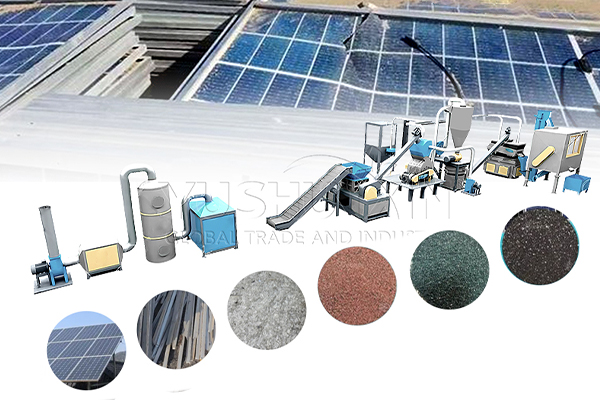
Mechanical recycling focuses on physical dismantling and separation. The process typically includes frame removal, glass separation, crushing, and sorting. This method is widely used for both single-glass and double-glass modules, especially in large-scale operations.
YUSHUNXIN mechanical recycling systems integrate frame removal machines and glass removal equipment at the front end, significantly improving efficiency. Afterward, controlled crushing and advanced separation technologies recover materials such as glass, aluminum, copper, and silicon fractions. For a real-world example of pure mechanical processing, the German 1000kg/h solar panel recycling facility demonstrates high-volume physical separation without thermal treatment.
Mechanical systems are preferred for their lower operational complexity, higher throughput, and strong scalability, making them suitable for most commercial recycling facilities.
Pyrolysis Technology: Targeted Material Separation
Pyrolysis involves thermal treatment of solar panels in an oxygen-free environment to decompose encapsulation materials such as EVA. This process can improve the separation of bonded layers, particularly in panels where mechanical methods face limitations. The technology can also enable precious metal recovery from solar cells, adding economic value.
A practical application combining both approaches can be seen in the Indian solar panel recycling project, which integrates mechanical preprocessing with pyrolysis to enhance silicon recovery purity.
However, pyrolysis systems require higher energy input, precise temperature control, and additional emission management systems. This increases both capital investment and operational complexity. As a result, pyrolysis is often used as a complementary process rather than a primary solution for large-scale recycling.
Matching Technology to Application
For mixed or large-volume panel waste streams, mechanical recycling remains the most practical and cost-effective solution. It handles different panel types efficiently while maintaining stable output quality.
Pyrolysis may be considered in specialized cases where deeper material separation is required or when targeting specific recovery processes. The choice depends on project scale, material composition, and economic objectives.
Practical Solutions for Real-World Recycling
Selecting the right technology is about balancing efficiency, cost, and operational reliability. As a manufacturer of solar panel recycling equipment, YUSHUNXIN focuses on delivering robust mechanical systems that meet industrial processing demands while supporting high recovery rates and stable performance.
By aligning recycling technology with panel types and business goals, operators can build efficient systems that maximize resource recovery and ensure long-term sustainability.
Leave a Reply