As a professional manufacturer of pyrolysis recycling equipment, we focus on designing reliable, efficient, and environmentally friendly systems that turn waste plastics into valuable fuel oil. Our machines are built with advanced technology, strict quality standards, and intelligent operation systems, ensuring stable performance and long service life. Below, we explain the working process step-by-step to help customers understand how our equipment brings real economic and environmental benefits.
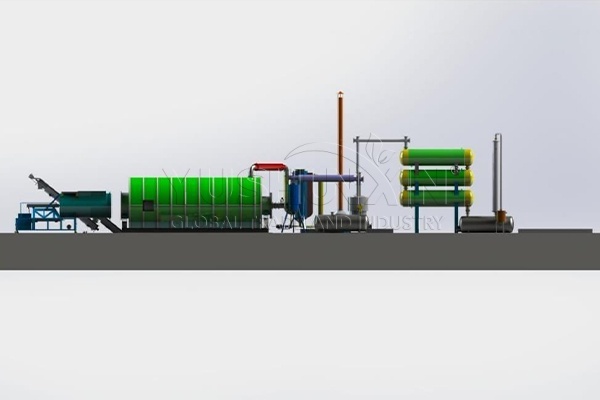
Feedstock Preparation and Loading
The process begins with sorting and preprocessing waste plastics such as polyethylene (PE), polypropylene (PP), and polystyrene (PS). These materials are shredded, cleaned, and dried to remove moisture and contaminants. Well-prepared feedstock ensures a consistent pyrolysis reaction and higher oil yield.
In industrial applications, preprocessing may also involve impurity removal and size reduction to guarantee smooth downstream operation. The prepared materials are then transferred into a high-efficiency plastic-to-fuel production line, operating under fully sealed and automated feeding conditions to maximize safety and stability.
Thermal Pyrolysis Reaction
Once the feedstock is loaded, the reactor is gradually heated in an oxygen-free environment. Without oxygen, plastics do not burn but decompose through thermal cracking. At temperatures between 300°C and 450°C, long polymer chains break down into smaller hydrocarbon molecules.
Our reactor integrates indirect heating and energy-saving insulation to maintain uniform temperature distribution. This optimized advanced thermal cracking system for plastics improves oil yield while reducing energy consumption and operational risks.
Vapor Conversion and Condensation
During pyrolysis, plastics release hydrocarbon vapors and light gases. These vapors enter a multi-stage condensation system where they are cooled and transformed into liquid fuel oil. High-quality stainless-steel condensers ensure efficient cooling performance and long-term durability.
For investors, oil output rate and equipment stability directly influence profitability. Many project developers carefully evaluate the plastic recycling return on investment potential before launching a new facility.
Gas Recycling and Energy Utilization
Not all generated gases condense into liquid oil—some remain combustible in gaseous form. Instead of being discharged, these gases are purified and reused as supplementary heating fuel inside the reactor system. This closed-loop energy design significantly lowers external fuel demand and operating costs.
Such integration makes the system a reliable choice for companies seeking scalable and environmentally responsible conversion technology.
Carbon Black Discharge and Emission Control
After the pyrolysis cycle is complete, the solid residue—mainly carbon black—is automatically discharged once cooled. This by-product can be reused in rubber manufacturing, construction materials, or pigment production.
At the same time, an advanced gas purification system removes dust and harmful components, ensuring emissions comply with strict environmental regulations and international standards.
If you are planning to build or upgrade a recycling facility, understanding equipment configuration and layout requirements is equally important.
Leave a Reply